Simulators
I will be adding free vibration simulators to this page in 2026… Understanding Mass, Stiffness and Damping https://zencovibrations.com/wp-content/uploads/Simulators/zenco_msd_simulator.html
Watch this video of my presentation at the International Maintenance Conference (IMC) in 2024 weighing the pros and cons of wireless sensors vs manually collected data. View it on YouTube: https://youtu.be/AGLTHVzzqUU?feature=shared This is a must-watch for anyone trying to build a modern, effective vibration monitoring program. Alan Friedman at the International Maintenance Conference (IMC) In…
Read more
The AIs Weigh in on the question: Are Harmonics Real or just an artifact of the FFT? This series is part of my LinkedIN newsletter. You can Subscribe on LinkedIn to get these and similar articles in your inbox. In Part 1 of this article I noted that a sine wave, perhaps created by a…
Read more
In Part 1 of this article I noted that a sine wave, perhaps created by a mass on a spring bouncing up and down, results in a single peak in the spectrum. If the spring gets more rigid as it gets compressed, the mass will move less in one direction than the other. We can…
Read more
In Part 1 of this article I noted that a sine wave, perhaps created by a mass on a spring bouncing up and down, results in a single peak in the spectrum. If the spring gets more rigid as it gets compressed, the mass will move less in one direction than the other. We can…
Read more
Are Harmonics Real? Are harmonics real or just an artifact or result of processing the waveform through the FFT? This is a question that comes up a lot among vibration analysts, or anyone working with signals and signal processing. What Are Harmonics? A sine wave has a single amplitude and frequency. Let’s say our sine…
Read more
Introduction Understanding Decibels: This is a very short video that describes the “half power point” in a filter in terms of decibels (dBs) as well as the 0.707 voltage point. It will also describe the linear range of a vibration sensor in terms of it’s +- 3dB points. Decibel units are frequently used in vibration…
Read more
You took the course and you passed the exam. The freshly printed certification hangs proudly above your desk and an electronic copy of it is displayed in your social media profile and email signature. You have crossed a major milestone! You have received a raise and a promotion! But, does this mean you are done…
Read more
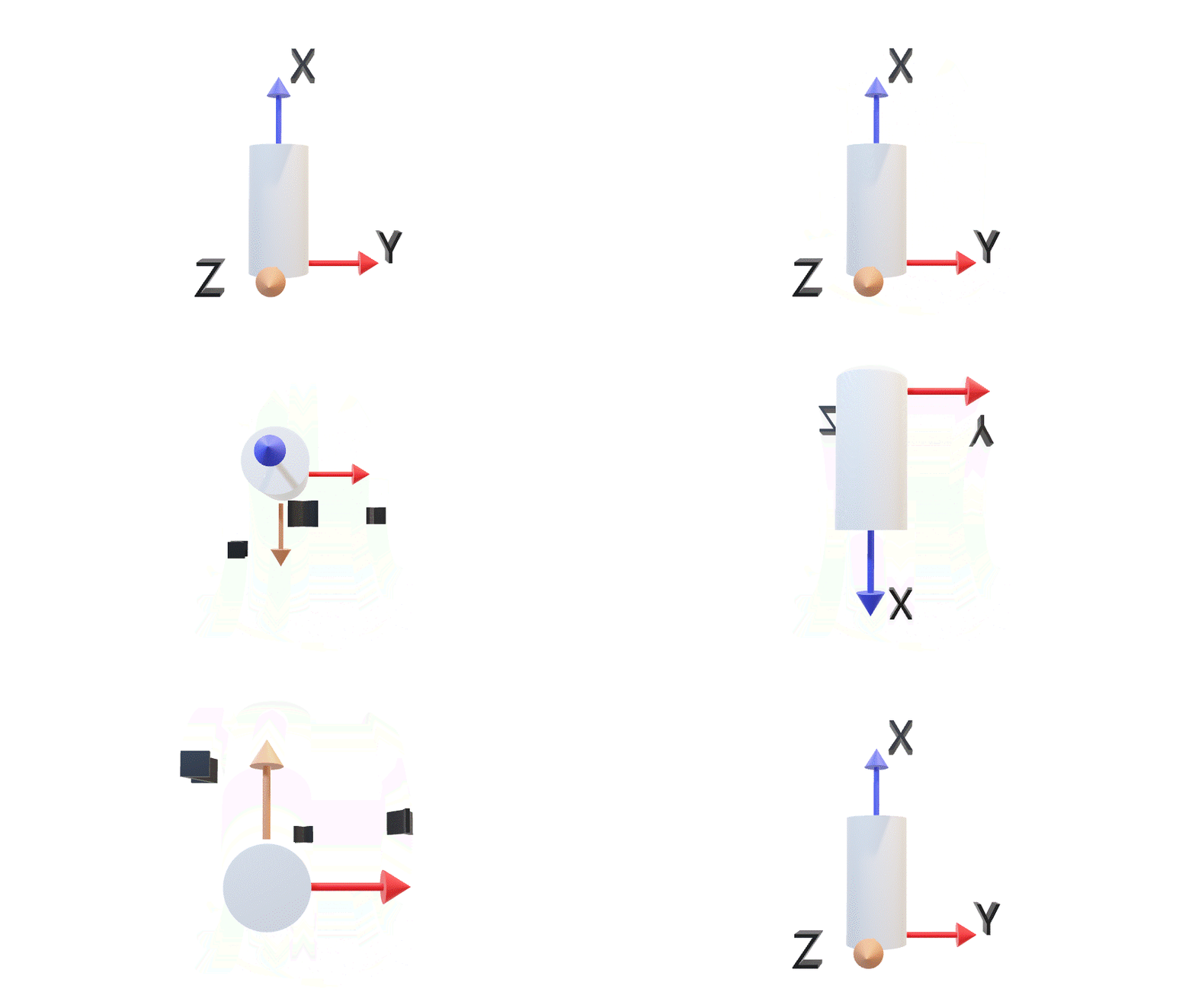
This short video by Alan Friedman from Zenco Vibration Experts explains the importance of defining sensor orientation for triaxial accelerometers. Whether you are taking readings on a route or using wireless sensors, this video has important information you need to know! Here’s the YouTube link if you want to share it: https://www.youtube.com/watch?v=2BIce8WDkcI It’s not enough…
Read more
Demystifying Demodulation and Enveloping The following is a brief description of this short video on demodulation and enveloping in vibration. To learn more, please message me, email me at ZencoVibe@gmail.com or check out my course schedule at https://zencovibrations.com You might want to have a look at my last two articles before you read this one…
Read more
In my last article I talked about linear and non linear systems. These systems contain frequencies, such as harmonics and sidebands, that are not in the inputs. In this article I share a short video I made with my signal processing simulator that demonstrates the concepts. Watch the video with the sound on. Feel free…
Read more
In this article I will explain linear and non-linear vibrations in an easy-to-understand, non-mathematical way and then I will relate these concepts to machinery vibration monitoring. Linear Systems The definition of a linear system is that the output is directly proportional to the input. If you hit a billiard ball in one direction, it will…
Read more
Importance of Setting up Alarms and Baselines in Machinery Vibration Analysis Machinery vibration analysis is an essential tool for monitoring the health of industrial equipment. It involves measuring the vibration of machines and analyzing the data to identify potential issues. One of the critical aspects of vibration analysis is setting up alarms and baselines to…
Read more
What is the difference between Brinelling and False Brinelling? What causes Brinelling and False Brinelling? Keep reading and find out! Brinelling Brinelling is named after the Brinell scale of hardness. In the Brinell hardness test, a small ball is pressed into the surface of a material using a specific amount of force. The size of…
Read more
Category 3 Vibration Analysis with Certification in Accordance with ISO 18436-2 4 Days. Optional 4 hr certification exam on day 5 The category 3 vibration course meets and exceeds requirements of ISO 18436-2. It is intended for students who have passed Cat II and wish to delve deeper into vibration analysis or manage CM programs.…
Read more
Unbalance Force Unbalance force in rotors lead to premature machine failure. Excess unbalance forces cause bearings and seals to fail prematurely. Excessive vibration can cause other problems. It is therefore important to precision balance rotors. We can define the unbalance force in two separate ways. First, Force (F) equals the unbalance mass (m) times the…
Read more
How do you use a Keyphasor(TM) to measure phase? We’ll answer that question in this short post. Proximity probes, also called eddy current probes or displacement probes, are used to measure vibration in journal bearings. These probes are permanently installed in the bearing. They measure the distance between themselves and the shaft. Two probes are…
Read more
Diagnosing an eccentric sheave with vibration analysis is easy to do. But you have to be careful not to mistake it for other common machine faults. For example, unbalance also shows up at 1x in the radial directions. Fortunately, you can always stop the machine, mount a dial indicator and measure the run out of…
Read more
Diagnosing a misaligned sheave is easy to do with vibration analysis. Note how the sheave moves in the axial direction, one cycle of vibration per rotation of the shaft (1x). Note the phase relationships. As the top of the sheave moves to the right, the bottom moves to the left – meaning they are 180…
Read more
Diagnosing a bent shaft with vibration analysis is easy to do, especially when you can visualize it using 3D animations. Sign up for a course and learn more: https://zencovibrations.com/events/ A bent shaft causes shaft rate vibration (1x) in all three axes. Depending on the location of the bend, one might also see an elevated 2x…
Read more